big babies and split digraphs

My five year old son would rather draw poo than write it. He mixes up his pronouns, puts his shoes on the wrong way round and comes out with charmingly preposterous assertions. (Why can’t we buy a balcony? Megalodons do exist). At the moment, he can spell his first name and read a smattering of three letter phonetic words, if pressed and incentivised by chocolate.

In approximately a year’s time, he will be asked by his teacher to read 40 words. 20 actual words and 20 non words. Non words like Bulm or Yewn or Foid. Lewis Carroll type words. (I like to picture the Government bureaucrat tasked with concocting these non words, leafing through the Jabberwocky for inspiration).

If my son gets fewer than 32 correct, he will fail. A cross will be marked, hopefully discreetly, in a document of some kind. He will be expected to re-sit the test the following year, and so on until he passes. But he won’t know it’s a test.

Or so we’re told.

It’s a false dichotomy, the pass and the fail. Just a means to aid assessment, they say. Nothing to worry about. But all the same, it might be an idea to up the level of support we’re providing at home, to compensate. Just a few minutes a day. Without passing on our concern. Because there’s nothing to worry about, really. The pass or the fail.

It all makes for a queasy mix.

As a parent it can be a hard act keeping a sense of perspective as our tricksy little grammatically unreconstructed darlings are put through their paces. My son learnt the meaning of the term ‘digraph’, before me. I don’t remember being taught grammar at school. Certainly not at the age of 4. As the kindly woman leading the Phonics course that the school facilitates, put it, in response to my anxieties: ‘he’s just a baby’. A baby learning grammar. And in today’s educational rat race, it’s never too early for a split digraph.


rhubarb and verjuice

I’ve got nothing against vanilla. And vanilla has got nothing against me. We can’t even have a fight, because there are no grounds for a fight. Our bullets are duds. But when faced with an array of flavours at my local and not at all parochial ice-cream parlour, I’m more likely to plump for rhubarb and verjuice, despite the fact that I have no idea what verjuice is. It sounds good, is all. It sounds like something a knight and his lady might quaff at a medieval banquet. In goblets. Luckily, there is a helpful bottle of verjuice on display on top of the counter. It is a kind of grape juice, I’m informed. Well there you go. Rhubarb and grape juice. Sounds delicious.

It got me thinking. Things have come to a pretty pass when the reason I’m attracted to a product is simply because I am drawn to the sound of an ingredient. A synaesthetic allure, appealing to both mouth and ear. Verjuice. Virginal. We’re back to damsels and Knights.

Perhaps it is time Vanilla got a rebrand. So here’s my scoop of suggestions:

Madagascan Manna

Very Vanilla

Not So Vanilla

Inscrutably Vanilla

It’s a hard nut to crack. Or pod to burst. I think I may need to move on.


a stick is a stick is a stick

It was a beautiful Spring-like day. Cold, but sparkling. Outside on the heath, I could see energetic fathers positioning the goalposts and jumping up and down like eager subs. Their kids, younger than mine, were getting kitted out, ready for a morning’s game of football, little poster children for a healthy, active life. Mine were slumped in their pyjamas, eyes glazed, fingering their devices. It wouldn’t do.  I kicked them out of the house, into the alarmingly cold air. They scowled.

Things got better when we found the stick in Greenwich park. It was the perfect stick. Thick, but not too thick, long, smooth, free from lateral sprigs or fibrous bits. It was straight and true as a light saber. Too good, in retrospect. For a few fleeting minutes, my two sons frolicked with the stick, enjoying the thrill of the find. And then the rancour set in. The youngest had found it and laid claim. Finders keepers. But the oldest wanted it just as much. A second stick would need to be found, every bit as perfect as this one. It soon became clear that there would be no second stick. And so the charade began. I needed a rationale to placate the youngest, in anticipation of the Darwinian struggle that was about to ensue. It was too big for him, I said. Better suited to the eldest. We would need to find a smaller, age appropriate stick. The older child immediately saw the wisdom in this.

“We’re looking for a stick that is as good as this but smaller because this one’s too big for you. OK Theo?”

We plodded around looking for the second stick. The blue sky, daffodils, and shimmering vista of the city at the foot of the hill, were lost on us. There would be no heart-lifting Spring like behaviour of the kind I fantasised about before frogmarching my boys to the park. No cavorting like carefree puppies. Instead, we spent the next ten minutes circling the perimeters of trees, our noses sweeping the ground like tracker dogs. We nearly found one. A decent stick, almost but not quite a contender. The older brother saw its merit. He picked it up, clipped off a couple of twiggy bits and made it good. Or quite good.

“Look Theo. This is a really good stick”.

“It’s curved”.

“It’s not curved”.

“I hate it”.

I intervened.

“I’m going to fling the stick over the fence”.

“NOOOOOO!!!” Both children cried out in unison, allies against a common enemy.

A resolution, of sorts.

lousy

Lousy. I only fully understood the meaning of the word when a small but persistent legion of lice stationed itself on my head recently. They found it congenial there, apparently, the little lice. Just the job. Fine views from the high ground and plenty of thick follicular cover made for optimum conditions. And a hardy crew they turned out to be. Immune, seemingly, to the special shampoos on sale at a not inconsiderably modest price, and guaranteed to eliminate the lot of them, eggs, nymphs, lice, the works. How they must have laughed as I emptied the contents on top of them, and waited stoically in the shower for ten minutes, as instructed, getting colder by the minute, but happy, at least, to be dishing out their last rites. Was I heck. They just hunkered down, en masse, and held their breath. Worked a treat.

Until a month ago, headlice were both an urban myth and a distant memory. They only invaded clean hair. They only invaded dirty hair. Once upon a time, before digital photography, when mums wore flares for the first time, I had nits. But that was aeons ago. And then, last month, my eldest son scratched his head. And even then, I didn’t believe, refused to believe, headlice were an actual thing, afflicting us, right now. They got to me, literally and metaphorically. Resisted the lotions. Resisted the comb. Overwhelmed my defences. Disturbed my peace. Just when I thought I was on top of it, prompt remedial action taken, up they popped again. Itch, scratch, bummer, comb. A carousel of gloom.

I’ve got a plan. There’s a business. Makes it its business to get rid of them, properly, naturally. I’ve booked an appointment for me and my son. “You can now relax”, the email reads. “If there are any nits and head lice in there we will find them”. It isn’t often in life that a problem can be guiltlessly transferred. My headlice are now out of my hands. And hopefully, soon, off my head.


put it away!

My youngest son is going through a pulling down his trousers phase. I find it a bit endearing and a lot infuriating. I can sort of understand why he finds it enjoyable. It never fails to induce squeals of embarrassment/delight/horror from the small people around him. It makes him the centre of attention. It is transgressive and therefore must give him a bit of kick. It probably feels nice to expose one’s cooped up parts to the breeze.

But it occurs to me that you don’t see little girls parading their pudenda with the same frequency or gusto. In fact I’ve never seen a girl do it in public. I don’t think I’m speaking out of turn when I say that you’re far more likely to see a small boy than a small girl indulging in a spot of genital exhibitionism.

It must be, partly, because there’s something there, in the male anatomy, that looks, inherently, comical. An appendage. A leaky spout. An odd piece of apparatus. A dangly afterthought. Whereas the female equivalent – it’s still much harder to name it – is less obvious, less silly looking, less nameable.

In the case of a small boy displaying his willy, the stock reaction is to laugh. Reprove, admonish as parents must, but also, acknowledge the joke. Ha ha look at the willy. Isn’t it funny. Isn’t he cute. Now put it away, there’s a good boy.

Not so, I dare say, with a small girl.

But there must be more to it than just the way things look. The very word, pudenda, derives from the Latin word for shame. Vagina, likewise, derives from the Latin for sheath, or scabbard. In other words it is not so much a thing in itself but a form of concealment. Something not to be seen.

I don’t know quite why I’m writing this or what conclusions to draw.

don’t go straying off the path

When I go for a run I follow the same route, more or less. I have two versions, a short and a long, which is the same as the short but a bit longer. They are circular, spill onto the Heath, and involve some moderate ups and downs. I don’t necessarily always stick to the same side of the road but I enjoy the familiarity of my tracks. It’s ritualistic. I look out for certain things: the zombiefied shop dummy propped up on a roof terrace overlooking the zebra crossing; the house of someone I know; a particular garden that I like. I don’t really push myself. I stop a few times to stretch, admire the view, blow my nose or take off my hat.

That’s just me. The other day I was talking to a friend who has recently taken up running. She is loving it and has already overtaken me in distance and frequency. I asked her whether she too follows the same route. The answer, to my surprise, was no. Not just no, but never. She always goes somewhere new. And she never stops.

‘Then I’ve got to find my way back again’.

Her answer stopped me in my tracks. What is it, I wonder, that stops me from doing the same? Surely not thoughts of the big bad wolf.

I won a typewriter

My fingers were the quickest off the keys at precisely 11.20 and 53 seconds, GMT, on Sunday 25 October. Bid submitted and confirmed. I was the highest bidder. It gave me a short sharp thrill of victory. I might have whooped.

Did you win it? My son asked, busying himself with the Lego.

Yes.

Yay! He said with acquisitive gusto.

My grandmother was a shorthand typist. It was a means to an end, an independent income that would free her from patriarchal dependence. But it was more than that. It was a means of expression. Over the seventy odd years during which she typed, she produced thousands of pages of typescript that are now in my possession, most of which go over the ground that nurtured her conviction; the curious intimacy she believed she shared with the economist John Maynard Keynes.

What hasn’t remained, more bafflingly, is the typewriter. My parents have no memory of it. My uncle, who would have known, died a few years ago.

I know it was a portable Underwood because she refers to it in her diaries from 1920, the time she worked for Keynes. I picture her cycling around Cambridge with it stowed in her pannier. It would have made her feel good, a sleek machine, the latest model, connected to the wider world of work and money. She liked to think of herself as a modern woman, a working woman, able to pay for a room of her own. And it would have thrilled her with its potential as a vehicle for translating her own thoughts and ideas (and emotions) into print. Not dissimilar to keeping a blog on the go.

According to a print ad from the 20s, the portable Underwood was: “light, sturdy, compact, it gives wings to words – enabling anyone to record ideas, clarify thoughts, express affections – to do Underwood Typewriting anywhere”.

The typewriter that I won is a portable Underwood 3. It looks like a model that might have been produced around 1920. It is on its way from Kendall. I am looking forward to ‘doing Underwood Typewriting anywhere’…

I won a typewriter

My fingers were the quickest off the keys at precisely 11.20 and 53 seconds, GMT, on Sunday 25 October. Bid submitted and confirmed. I was the highest bidder. It gave me a short sharp thrill of victory. I might have whooped.

Did you win it? My son asked, busying himself with the Lego.

Yes.

Yay! He said with acquisitive gusto.

My grandmother was a shorthand typist. It was a means to an end, an independent income that would free her from patriarchal dependence. But it was more than that. It was a means of expression. Over the seventy odd years during which she typed, she produced thousands of pages of typescript that are now in my possession, most of which go over the ground that nurtured her conviction; the curious intimacy she believed she shared with the economist John Maynard Keynes.

What hasn’t remained, more bafflingly, is the typewriter. My parents have no memory of it. My uncle, who would have known, died a few years ago.

I know it was a portable Underwood because she refers to it in her diaries from 1920, the time she worked for Keynes. I picture her cycling around Cambridge with it stowed in her pannier. It would have made her feel good, a sleek machine, the latest model, connected to the wider world of work and money. She liked to think of herself as a modern woman, a working woman, able to pay for a room of her own. And it would have thrilled her with its potential as a vehicle for translating her own thoughts and ideas (and emotions) into print. Not dissimilar to keeping a blog on the go.

According to a print ad from the 20s, the portable Underwood was: “light, sturdy, compact, it gives wings to words – enabling anyone to record ideas, clarify thoughts, express affections – to do Underwood Typewriting anywhere”.

The typewriter that I won is a portable Underwood 3. It looks like a model that might have been produced around 1920. It is on its way from Kendall. I am looking forward to ‘doing Underwood Typewriting anywhere’…

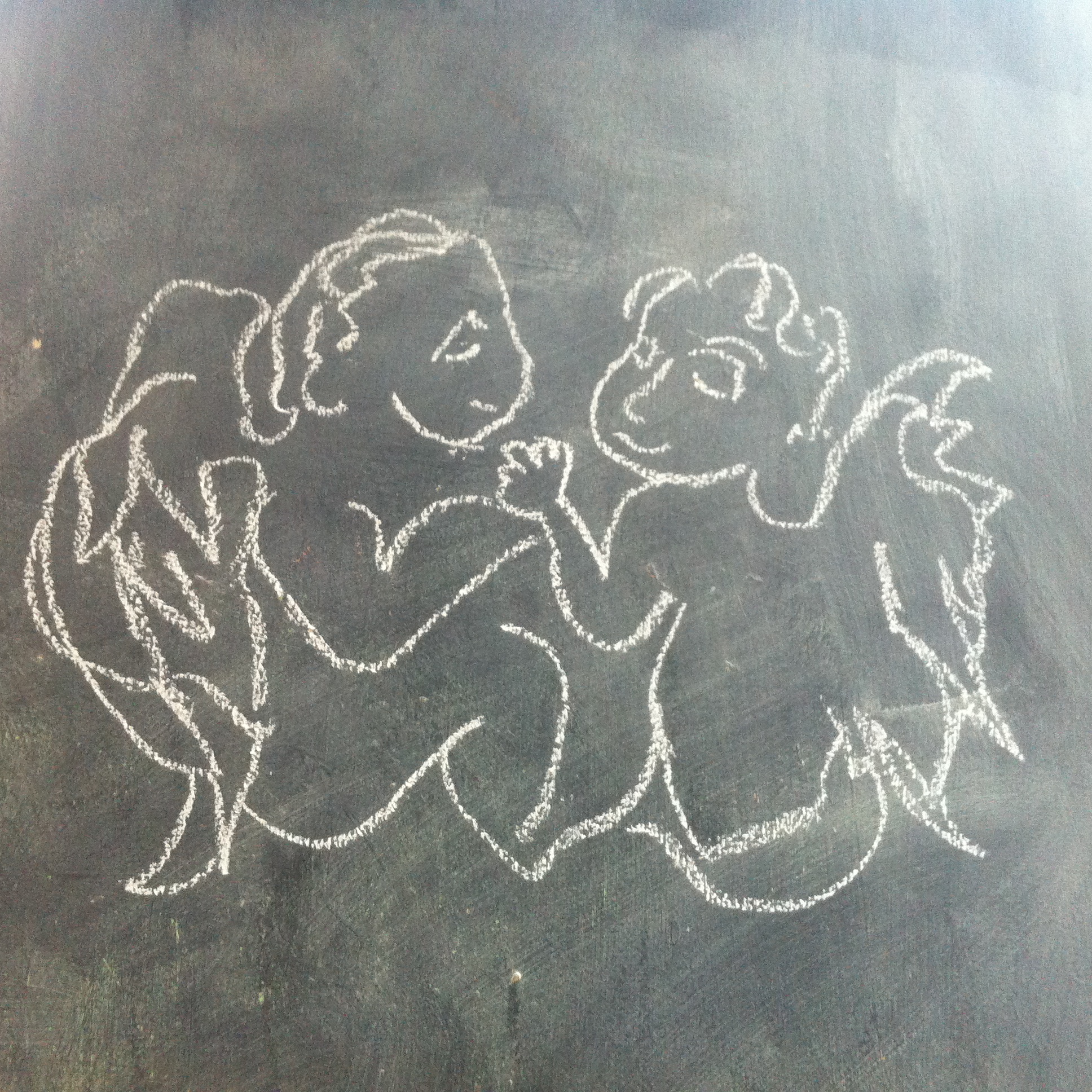
two cherubs, an amaryllis and a wig

My grandmother liked to teach from natural observation. Her young charges would be expected to go out with paper and pencils, study nature and record their findings. The stamens of a tulip. The exoskeleton of an earwig. The blue in a magpie’s wing. Observation was key. The more detailed the studies, the more finely moulded the mind.

Today I’m putting her method to the test and heading out into my environment, armed with pen, paper and a keen pair of eyes.

I started off well, spying, to my delight, two stone cherubs on a balcony of a neighbouring house, turned towards each other as if in conversation. I’ve lived on this street for over ten years but never noticed the cherubs. Perhaps they’re a new addition. Perhaps they’ve been here, unobserved by me, for decades. Maybe they turned to stone over millennia, like petrified trees, too cold and tired to talk any more.

2015-10-19 14.57.59

Once on the high street a rush of sense impressions overwhelmed me until I noticed a row of amaryllis spears, thrusting phallically from their terracotta pots. Little green rockets of recovery. Harbingers of glory in the bleakest of midwinters. My grandmother would have been proud.

In the main, though, high street distractions are more likely to be of a synthetic than natural variety. Once again I noticed a pair of gold ankle trainers. And in the charity shop, a spectacular maroon afro wig. I tried it on, and looked at myself in the mirror. I looked foolish.

“Too much”, I said, disingenuously (the too muchness being the point).

“Why not go for the axe-wielding bunny girl look, instead?”  The sales assistant suggested, pointing to a shaggy platinum blonde wig on display next to a large plastic axe. It’s Halloween, soon.

“Well, OK”, I said, willing to be humoured. I tried on the blonde wig thinking I might aspire to a deranged Marilyn Monroe look while out trick or treating with my sons. I still looked foolish.

“No thanks”, I said, and bought the axe.

On my way home, I pondered my catch: the cherubs, the phallic plants and the charity shop schlock. The pure, the impure and the imperfect.  A name occurred to me. Mimi Von Klamp. My burlesque alter ego? I have my grandmother to thank.

don’t be scared, it’s only a cinema…

Houses are like people. They have facades. What you find on the inside is not necessarily what you see on the outside. I went to the cinema, once, and got lost on my way out. Instead of ending up where I came in, by the brilliantly lit ticket hall and popcorn counter, I found myself in a large, deserted courtyard. It was odd. I’d gone from a packed auditorium, down a long flight of stairs and out into an empty space. Or at least I thought it was empty. Then I noticed a solitary figure, a man, smoking, diagonally across from me on the other side of the yard. Despite being in the centre of town, I felt a long way from the madding crowd. All of a sudden I was in my own movie, a psychological thriller, in which the ground had shifted and I no longer knew where I was or who I was with. One wrong flight of stairs can get you into a whole lot of trouble, or so the strapline of my film ran. I said hello to the man to break the silence. He said hello back, in a mild, sociable manner. The tension broke. I no longer felt I was about to be murdered in an unfortunate twist of fate. I asked the man where we were. He said we were at the back of the Bingo Club. Moments later I was on the high street again, after a strange snaking route via the glittering, hangar like space that is Mecca, adjacent to the cinema, empty but for a cleaner. Luckily, my number wasn’t up.